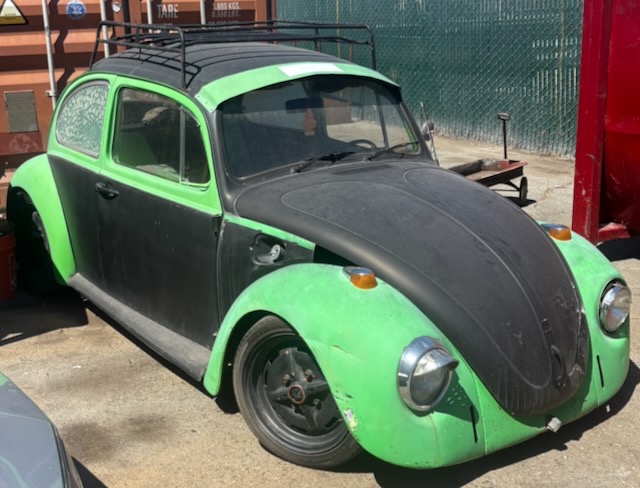
I bought a 1968 Beetle for a thousand bucks. Salvage title. Front end hacked up from an old collision and somebody’s dropped axle. It shows up in my driveway on August 1st.
And instead of ordering parts, I spent two hours answering questions from a chatbot.
Stay with me here.
The problem with AI is that it doesn’t know you
If you’ve used ChatGPT or Claude, you know the feeling. You ask it something about your car and it gives you an answer that’s technically fine and completely useless. It explains what a torsion beam is. It suggests you “consult a professional.” It writes like a brochure.
That’s not the AI being dumb. That’s the AI having no idea who you are.
Every time you open a new chat, you start over. Here’s who I am. Here’s what I’m working on. Here’s how I want you to talk to me. No, not like that. It’s like hiring a mechanic and re-explaining the whole car to him every single morning.
There’s a guy named Jeremy Utley who put a name on the fix. He calls it a Teammate Stack. The idea is dead simple: instead of re-introducing yourself forever, you write it all down once, in a handful of files, and hand them to the AI at the start.
Then it already knows.
What I actually did
Eight files. Plain text. That’s the whole thing.
I know “plain text file” sounds like something an IT guy says right before
you stop listening. It’s not complicated. It’s a document with no
formatting — no fonts, no colors, nothing. Just words. You can open it in
Notepad. The file ends in .md, which stands for Markdown, which is a
fancy word for “text with a couple of asterisks in it when you want
something bold.” That’s it. That’s the whole technology.
The reason to use it instead of Word is that a text file will still open in forty years, works with every tool on earth, and doesn’t quietly corrupt itself. The dumbest format wins.
Here’s what the eight files cover:
- Identity — who I am, what car this is, what “done” means to me
- Voice — how I talk, so when it writes something it sounds like me
- Anti-style — what it must never do (more on this in a second)
- Context — where the project stands right now
- Rules — how it should work with me
- Opening move — the sentence I type to start every session
- Connectors — where all my project files live
- Leverage — how to stop doing the same boring thing over and over
I didn’t write these files. I answered questions, and the AI wrote them. It interviewed me — one question at a time, and it wouldn’t let me be lazy about it.
How long it took and how deep it went
Two hours. Maybe a little more.
And I want to be honest about the kind of two hours, because “two hours” sounds like nothing until you’re in it.
It asked what car it was. I gave it the VIN, the engine number, that the transmission number is unknown, that the tunnel stamping matches the title but both VIN plates are gone. It asked about condition, and I described the good frame head, the solid A-pillars, the rust under the back seat, the front sheet metal that’s going to need new quarters and a new gas tank.
It asked what “restored” means to me. I said a clean, respectable driver I’m not afraid to park in the driveway — not a concours car, not a trailer queen. It wrote that down and it never suggested concours paint again.
It asked about my budget. Ten grand, purchase included, soft ceiling. It asked about my schedule. Full time job, few nights a week, part of most weekends, and I don’t want to burn out in month three.
Then it started asking harder questions.
It asked how I want to be told I’m wrong. I said: don’t refuse to help me, but tell me how dumb the thing I’m about to do is. We built a 1 to 10 stupidity scale. Pulling the front beam with one hour of daylight left when it’s a four hour job? That’s a 3. Worth mentioning. Doing any work on the car before the title is clean and the state agrees I own it?
That’s a 10. And it will tell me so, every time, until it’s fixed.
It asked where logging would break down. Not if. Where. I said the truth: I’m going to finish at eleven at night, covered in grease, and I am not opening a laptop. So we designed around that. I talk into my phone for ten seconds — “three hours, pulled the front beam, torched two bolts, zero dollars” — and later, at a desk, the AI turns that mumbling into a proper log entry. The thing I have to do when I’m exhausted costs me nothing. The thing that takes discipline gets done by the machine, in daylight.
That’s the level of detail. It wasn’t filling out a form. It was more like onboarding somebody who’s actually going to be there all year.
The part where it saved my ass
Somewhere in the middle of describing the car, I mentioned the title situation. The pink slip is signed in one spot but not the other two. The guy whose signature I need has moved to Arkansas. He’s cooperating right now because he owes money to the woman who ended up with the car, and she’s still holding a bunch of his stuff.
The AI stopped and said, in effect: that leverage isn’t yours, it’s hers, and it can disappear.
And then it wrote a rule into the stack that I now cannot escape:
Nothing comes apart until the title is signed and in hand.
A partially assembled Beetle with a bad title is a car. A pile of parts with a bad title is scrap.
I knew that. Somewhere. But knowing it in the back of your head at 9pm on a Saturday when you’ve got a socket in your hand and the front beam is right there is a completely different thing than having it written into the system that greets you every time you sit down.
That single rule might be worth the whole two hours.
Why the “anti-style” file matters more than you’d think
One of the eight files is nothing but a list of things the AI must never do.
I told it: no “let’s dive in.” No rage-bait. No fake drama about whether the engine will start. No stretching a five minute idea into a fifteen minute video. No explaining what a pan is to an audience of Beetle people who obviously know what a pan is.
And one hard rule that I think everybody doing this should steal:
Never let an estimate look like a spec.
Sometimes there’s no torque spec. You’ve got a 13mm bolt on a stud going into a magnesium case and the manual is silent. Fine — we reason it out and pick a number. But when we do that, the AI has to say so out loud, show its reasoning, and label it as a judgment call and not gospel.
Because people are going to read this stuff and go work on their own cars. A labeled guess is useful. An unlabeled one gets somebody hurt.
What I get out of it
Four files that live alongside the eight:
- a work log — every session, hours, parts, dollars
- a ledger — every dime against the ten grand, reconciled once a week
- a parts inventory — where every removed piece is and what it needs
- a decisions file — what I chose and why, so I stop re-arguing with myself in February about something I settled in September
And here’s the sneaky part. After a few months of logging real hours, the AI stops guessing how long things take and starts knowing how long they take for me, in my garage, with my tools. Nobody’s blog post can tell you that. Only your own data can.
Better yet: the log is the blog post. Every entry is raw material. The documenting and the writing turn out to be the same act, which means the content mostly writes itself over the next twelve months.
Was it worth two hours?
I haven’t turned a wrench yet, so ask me in a year.
But I’ll say this. Two hours is roughly what I’d spend cleaning one wheel well. And what I’ve got now is a project manager who never forgets the budget, never forgets why I chose disc brakes, never forgets that the title isn’t clean, and will tell me — on a scale of one to ten — exactly how stupid the thing I’m about to do is.
The default AI is a Swiss Army knife. Useful for anything, great at nothing. Two hours of setup and it’s a scalpel that only knows one car.
The car shows up August 1. The title’s still unsigned.
Guess what I’m working on first.